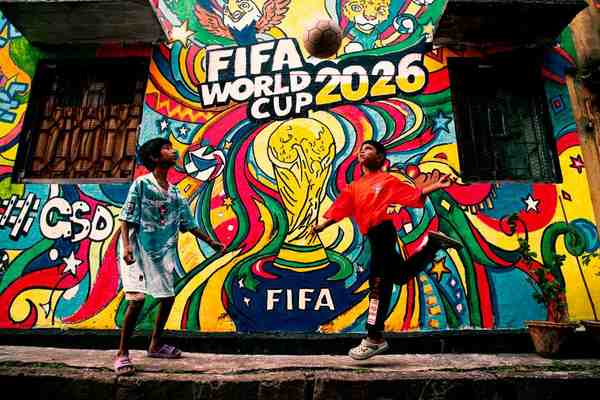
The first 48-team World Cup has only just finished, yet debate over the tournament’s next expansion is already gathering pace. The latest 2030 World Cup expansion news centres on a CONMEBOL-backed proposal to increase the finals from 48 to 64 national teams for the centenary edition. It is a dramatic idea, but not an approved plan. FIFA has said the proposal will be examined through its decision-making bodies, so the current 2030 World Cup format remains unchanged for now.
That distinction matters. A 64-team tournament would reshape qualification, scheduling, hosting responsibilities and the identity of the World Cup only four years after the move from 32 to 48 participants. Supporters see a once-in-a-century opportunity to make the event more inclusive. Critics see a tournament at risk of becoming too large. Either way, it is now one of international football’s biggest governance questions.
Where the 64-team proposal came from
The idea was raised within FIFA’s leadership structure by Uruguayan football officials and then promoted more publicly by CONMEBOL president Alejandro Domínguez. The South American confederation argues that the 2030 centenary deserves a unique celebration, especially because the first World Cup was staged in Uruguay in 1930.
Under the approved hosting plan, Morocco, Portugal and Spain will stage the main tournament. Uruguay, Argentina and Paraguay will each host a centenary match before the competition continues across Europe and North Africa. The CONMEBOL expansion campaign is closely connected to the belief that South America should have a larger role than three commemorative fixtures.
FIFA president Gianni Infantino has not ruled out the idea, but he has not confirmed it either. His position is that the proposal deserves formal examination following the 2026 tournament. Any suggestion that 64 teams are already guaranteed for 2030 is therefore premature.
How a 64-team 2030 World Cup format could work
FIFA has not published an official competition model for a 64-team event. The most obvious structure would be 16 groups of four teams, with the top two in each group progressing to a round of 32. That would create a balanced knockout bracket without requiring a ranking system for the best third-placed teams.
Such a format would produce 96 group-stage matches and 31 knockout matches, for a total of 127 games. By comparison, the 48-team tournament uses 12 groups of four and 104 matches. A 64-team World Cup would therefore add 16 participants and, under this model, 23 fixtures.
Other designs are possible, but every option would have consequences. FIFA must consider competitive balance, rest periods, travel, television scheduling and the event’s overall length. The FIFA tournament size cannot be increased simply by adding more names to the draw.
Why CONMEBOL supports expansion
A bigger centenary celebration
For South American officials, 2030 is not an ordinary World Cup. It marks 100 years since Uruguay hosted and won the first edition. Expanding the field would create the largest international football tournament ever staged and could support calls for more matches in Uruguay, Argentina and Paraguay.
More nations would have a route to qualify
A 64-team finals would include more than 30% of FIFA’s 211 member associations. It would create opportunities for countries that have rarely, or never, reached the World Cup. Confederations with developing national teams could argue that broader access encourages investment in coaching, youth systems, facilities and domestic football.
More commercial opportunities
Additional matches could provide more broadcast inventory, sponsorship opportunities and ticket revenue. FIFA could also reach new markets and give more supporters a direct connection to the finals through their national teams. Commercial potential is not the only consideration, but it will be part of the discussion.
The strongest arguments against 64 teams
Player welfare and calendar pressure
The international calendar is already crowded. Although teams eliminated early would still play only three group matches, the event would require more venues, more matchdays or more simultaneous games. Any redesign must protect recovery time and avoid creating further conflict with club football.
Questions about sporting quality
Expansion gives more countries access, but critics worry that rapid growth could produce more one-sided matches. The World Cup moved from 32 teams to 48 in 2026, so another increase in 2030 would mean the field had doubled within eight years. FIFA would need evidence that a larger competition improves global football without weakening the standard that makes qualification special.
Logistics across six host nations
The approved 2030 plan is already complex, with matches across six countries and three continents. Adding teams would increase accommodation needs, training sites, transport operations, security planning and costs. It could also require revisions to venue agreements prepared for the existing structure.
Qualification would need to be redesigned
Allocating 16 additional places could become politically difficult. Every confederation would seek a fair share, while FIFA would need to preserve competitive legitimacy. Larger regional allocations might also reduce the intensity of some qualifying campaigns. No official slot distribution exists because the expansion has not been approved.
What happens next?
The proposal must move through FIFA’s governance process. That is likely to involve technical analysis, consultation with confederations, assessment of the international calendar and a formal decision by the appropriate FIFA bodies. Host associations would also need clarity because a larger event could change infrastructure, budgets and operational planning.
The performance of the 48-team format will influence the debate. FIFA can now study match quality, fan demand, scheduling, travel and commercial results from 2026. If the expanded tournament is judged successful, supporters of 64 teams will use that evidence to strengthen their case. If major problems are identified, resistance will grow.
Frequently asked questions
Has FIFA confirmed a 64-team World Cup for 2030?
No. FIFA has agreed to consider the proposal, but the format has not been approved. The established plan remains based on the current tournament structure unless FIFA formally changes it.
Who proposed the CONMEBOL expansion plan?
The idea emerged from South American football leadership, with Uruguayan officials raising it and CONMEBOL president Alejandro Domínguez becoming its most prominent advocate.
How many matches could a 64-team World Cup have?
A format of 16 groups of four followed by a 32-team knockout stage would contain 127 matches. FIFA has not confirmed that structure, so the figure is an illustration rather than an official total.
Where will the 2030 World Cup be hosted?
Morocco, Portugal and Spain are the main hosts. Uruguay, Argentina and Paraguay will each stage a centenary match, creating a tournament across six countries and three continents.
A landmark idea, but not yet a landmark decision
The 64-team proposal fits the scale and symbolism of the World Cup’s 100th anniversary, and it promises wider global participation. It also raises serious questions about quality, qualification, logistics and player welfare. For now, the most accurate reading of the 2030 World Cup expansion news is that FIFA is considering a major change, not preparing to implement a confirmed one. The next stage depends on whether football’s decision-makers believe bigger truly means better.